Productos
Differences between kosher certifications around the world
Not all kosher certifiers follow exactly the same criteria. Knowing these differences helps you choose products with confidence.
Although the fundamental principles of kashrut are universal, there are hundreds of certifying agencies in the world, and each can have slightly different criteria on specific topics — for example, what level of supervision it requires for bishul akum, or how it handles certain chemical additives whose origin is hard to trace.
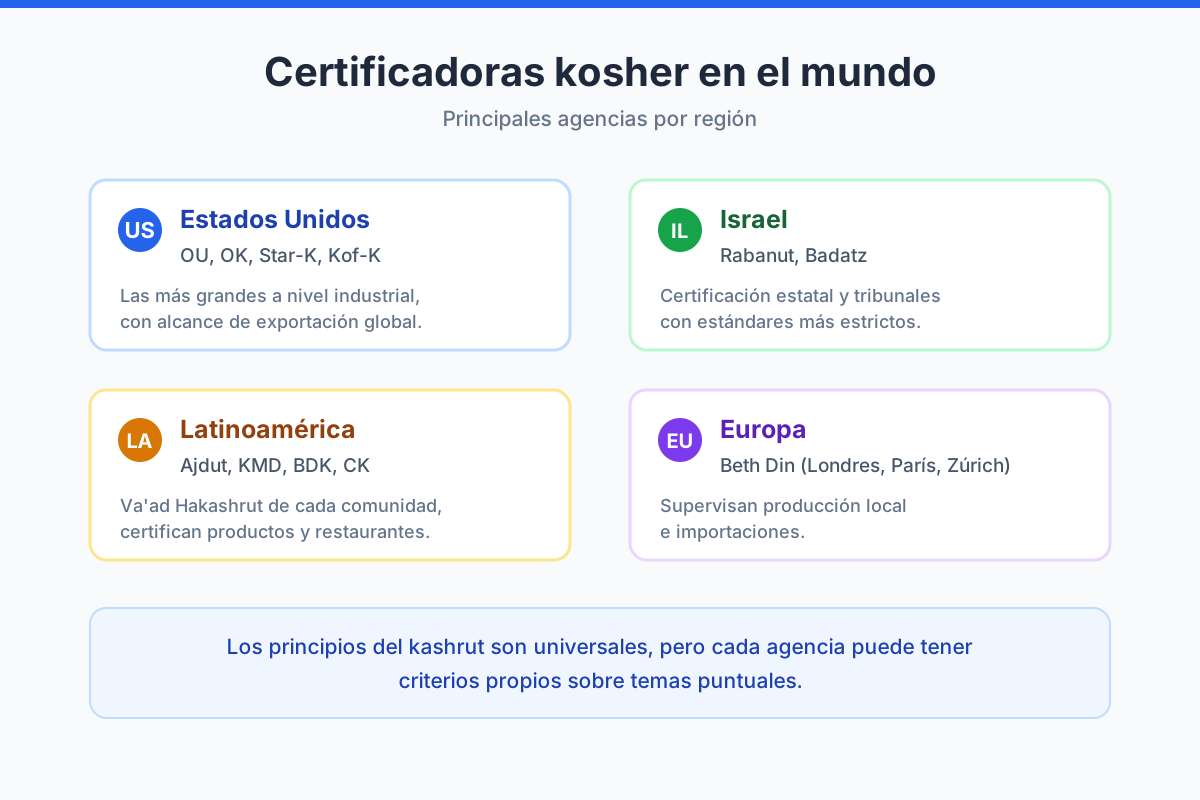
How certification varies by region
- United States: home to the largest industrial certifiers (OU, OK, Star-K, Kof-K), with highly standardized processes for mass export. A product certified there tends to reach dozens of countries in almost the same form.
- Israel: the Rabbanut (chief rabbinate) offers official state certification, while organizations like the Badatz maintain additional standards considered stricter by certain communities, sometimes resulting in two levels of certification on the same product.
- Europe: certifiers like the Beth Din of various cities (London, Paris, Zurich) supervise both local production and imports, adapting to markets with less industrial scale than the United States.
- Latin America: each community usually has its own local Va'ad Hakashrut (for example, in Buenos Aires, São Paulo or Mexico City), which certifies both local products and restaurants, generally with a scope limited to its own city or country.
Why there isn't just one single agency
Unlike other quality seals, there is no single central authority for kashrut worldwide. Each certifier answers to its own chain of supervising rabbis, and its recognition is built over time, based on the trust other communities and rabbis place in it. That is why a certifier can be highly respected in its country of origin and practically unknown elsewhere, without that meaning it is any less serious.
What to do with a seal you don't recognize
For the consumer, the most important thing is to learn to recognize the active certifiers in their region (covered in more detail in kosher certification symbols). And when in doubt about an unfamiliar symbol, consult the community rabbi or look into the agency's reputation before trusting a product. Most large certifiers publish public lists of certified products on their websites, which is especially useful when buying imported goods.
Frequently asked questions
Is a product certified in one country automatically accepted in another?
Not always. It depends on mutual recognition between certifiers and on each community's criteria; some families only trust a limited list of agencies, regardless of where the product comes from.
Is there a single global list of trustworthy certifiers?
There isn't one official list, but many regional rabbinic organizations publish their own lists of agencies they recognize, which serve as a practical reference.
Why do some products carry two or three different seals?
This usually happens when the manufacturer wants to reach markets or communities with different trust criteria, and seeks approval from several recognized agencies in each region.
Related reading
To recognize the most common symbols at a glance, see the most common kosher certification symbols. And to understand all the information a label can carry beyond the seal, see how to read a kosher product label.
📰 You might be interested
Productos
Kosher wine: why it needs special supervision
Wine has a particular status in halacha: to be kosher, it must be made and handled exclusively by observant Jews.
Productos
Kosher gelatin: the halachic debate
Gelatin is one of the most debated ingredients in the kosher world, because its animal origin can compromise its status.
Productos
Alcohol and spirits: what it takes for them to be kosher
Whiskey, vodka, rum and other spirits are often kosher by nature, but there are important exceptions to keep in mind.
Productos
The most common kosher certification symbols
OU, OK, Star-K, KSA... there are dozens of kosher certification symbols around the world. We help you recognize the most common ones.